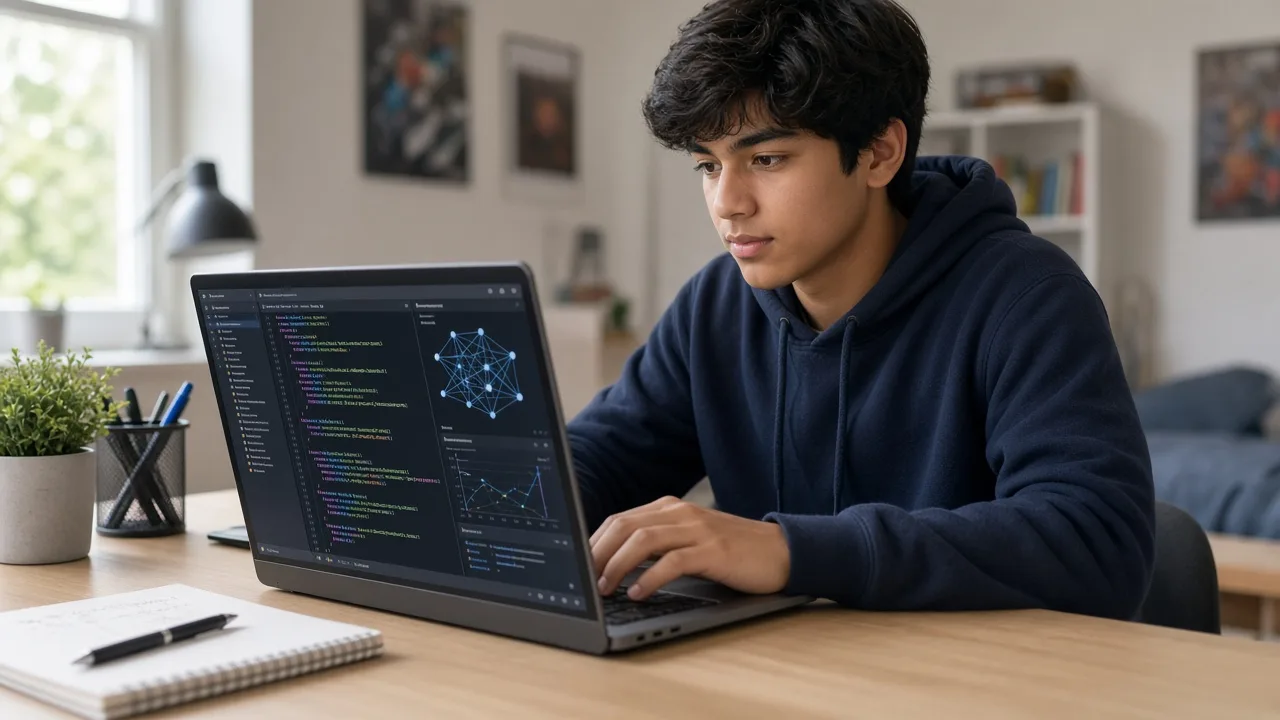
A Student Ready to Type
Comfortable with a keyboard and ready to move past block coding.
Live Java for students ready to type real code — 30 sessions to a capstone app
The first paid 60-minute live demo is $2.08, adjusted on enrolment, and you get a written learning plan afterwards.
 Capstone app
Comfortable with a keyboard and ready to move past block coding.
Wants Java practice that matches how many schools introduce programming.
Likes puzzles, games, and seeing a program do exactly what they planned.
Wants a finished Java project they can show at home or in class.
Tap each module to explore topics, projects, and what your child will build step by step.
Hello Java
Question and answer program
Modules, topics, projects, and typical live-class time — so parents know exactly what their child will learn. Typical full-course pace: 2 sessions per week · about 4 months (30 live sessions).
| Module | Focus | Duration | Topics covered | Projects / activities |
|---|---|---|---|---|
| 1 | Foundations | 8 sessions | How a Java program starts and prints output; Variables, numbers, text, and reading input; First programs a student can run on their laptop | Hello Java; Question and answer program |
| 2 | Logic | 8 sessions | if / else decisions; for and while loops; Methods that split a program into clear steps | Decision quiz; Loop practice |
| 3 | Games | 8 sessions | Scores, turns, and simple game loops; Arrays and lists for storing data; Debugging when a program does the wrong thing | Guess the number; Score-based game |
| 4 | Capstone | 6 sessions | Choose a quiz, game, or utility app; Build it in stages with mentor review; Test it and present the finished program | Capstone Java app; Live demo |
Screenshots and walkthroughs from mentor-guided Java builds — so parents can see the kind of work kids ship.
Short Java programs that ask questions, check answers, and keep a score — first variables, input, and if / else.

A turn-based or guess-the-number game that uses loops, a score, and methods so the code stays readable.
A quiz, utility, or game the student plans, builds in stages, tests, and demos at the end of the 30 sessions.
Best after a child can type and follow multi-step instructions. Scratch or a little Python helps, but it is not required. A laptop and stable internet are enough. Aimed at Grade 6–12.
Course prices are for live 1:1 Super Mentors sessions with hands-on projects and parent updates. Prices shown in USD $ for United States families (approximate local estimates). Try a session before enrolling.
Pay $110$140 after each 10 sessions
$330$420 for 30 classes
2 sessions per week · about 4 months
Personal attention & fastest progress
View plan details →Parent guides and STEM articles that pair well with Java.
Straight answers for parents comparing live Java classes, syllabus depth, projects, and pricing.
GeekashramJr's Java course is a 30-session live track for Grade 6–12. Students write real Java: variables and input, decisions and loops, methods, lists, a small game, and a capstone app they test and present with a mentor.
Java is taught live module by module (30 live sessions). Parents can review the full syllabus table on this page — topics, projects, and typical session time per module — plus download the curriculum brochure.
Students complete mentor-guided projects throughout the course. By the end they typically have: Written Java programs that take input, make decisions, and repeat work with loops; Built a small Java game or quiz with a score; Finished a capstone app and presented how it works. Sample project screenshots and walkthroughs are shown above.
Java is for students in Grade 6–12. Best after a child can type and follow multi-step instructions. Scratch or a little Python helps, but it is not required. A laptop and stable internet are enough. Aimed at Grade 6–12.
GeekashramJr Super Mentors 1:1 is $11 per session with personal attention. Prices are shown in USD, matching /pricing/usa. Try a session for current offers.
Classes are live online with GeekashramJr mentors — not passive video courses. Students get real-time feedback, debugging help, and project reviews in every session.
Students write real Java across 30 live sessions: variables and input, decisions and loops, methods, lists, a small game, and a capstone app they present.
No. Scratch or a little Python helps, but it is not required. The course is aimed at Grade 6–12 students who can type and follow multi-step instructions.
The syllabus is 30 live sessions, usually about 4 months at two sessions a week.
Try a Java session for students Grade 6–12. Meet a mentor, see the teaching style, and get a personalized plan for your child.
Try a session