At school, children learn maths, science, languages, and coding. They do not often learn how to use money: how to save, how to plan a budget, how to compare prices, or how a small shop makes a profit.
Financial literacy for kids means helping children understand money and make simple choices. With easy games, they can learn to save, spend with a plan, and see the value of what they buy. This helps in primary school and in the teen years.
This guide has 10 money skills, a ₹500 budget sheet, a small-business profit and loss example, three home games, and a quiz. For live classes with a mentor, use the Financial Literacy course for Class 3–12. If your child has a business idea, add Startup & Entrepreneurship.
What do kids need to know about money?
They need the idea, and they need to use it. It is not a list of hard words to remember.
- Tell needs from wants.
- Save for one clear goal.
- Make a simple budget that fits the money they have.
- Compare price, size, and quality before they buy.
- Know income, expenses, profit, and loss.
- Think before they spend.
- Spot common online payment tricks.
Let children try, make a small maths mistake, and try again. Extra free ideas are on the CFPB youth money page and activity list. The rupee examples below match pocket money and UPI that many GeekashramJr families already see at home.
Why should children learn about money early?
Kids see money long before they grow up. They get pocket money. They save for a toy. They shop with you. They see a card or UPI pay in seconds. Easy practice now builds skill. It should not make them worry about family bills.
10 money skills every child should learn
1. Needs vs wants
Needs you must have: food, basic clothes, and school things. Wants are nice but not must-haves: a new game, an extra toy, or more shoes when they already have enough.
Try this: Give 10 items (notebook, lunch, toy, water bottle, game add-on). Ask your child: need or want, and why. Some answers depend on the day. The aim is thinking, not shame.
2. Saving money
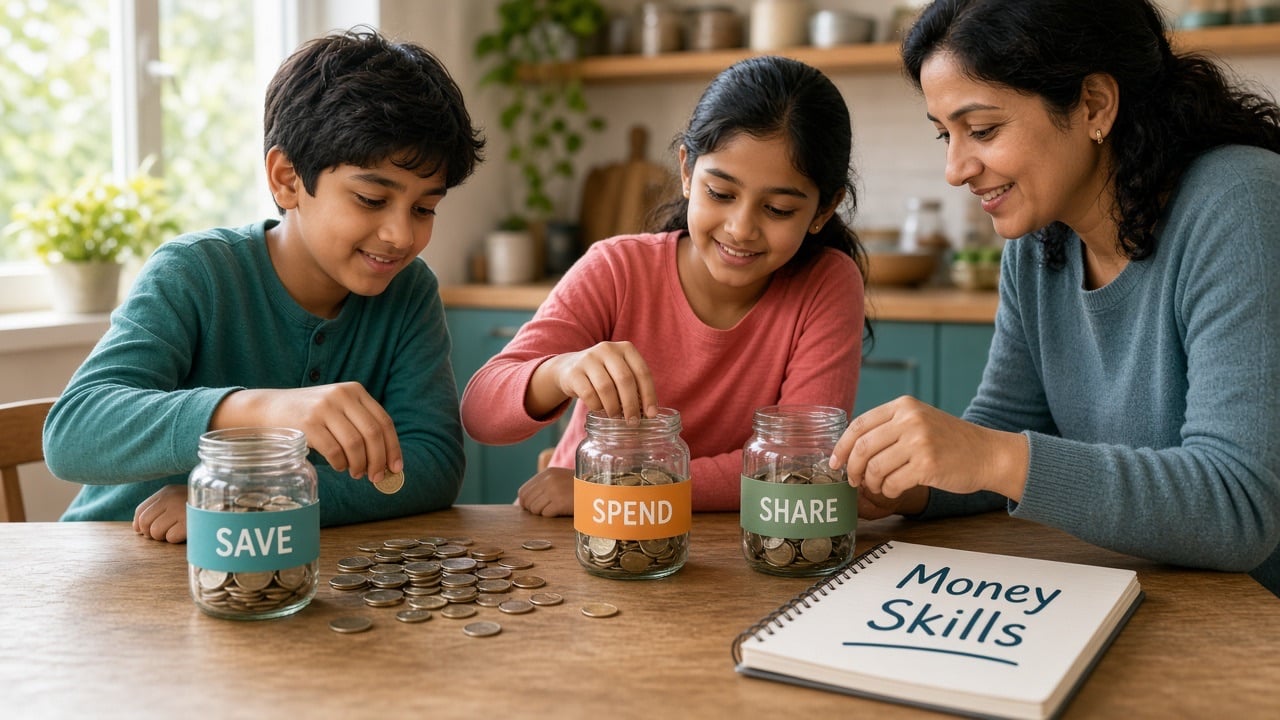
Saving means keeping some money instead of spending all of it now. Pick one goal. Write the price, how much they already have, and how much they can put in the jar each week.
Example: Aanya wants a science kit. It costs ₹600. She has ₹0 in the jar. She gets ₹100 pocket money each week and puts all of it in the jar.
| Plan | Aanya’s numbers | Your child |
|---|---|---|
| What they want | Science kit | |
| Price | ₹600 | |
| Already saved | ₹0 | |
| Save each week | ₹100 | |
| Weeks needed | ₹600 ÷ ₹100 = 6 weeks |
| Week | Put in this week | Total in the jar | Still needed |
|---|---|---|---|
| Week 1 | ₹100 | ₹100 | ₹500 |
| Week 2 | ₹100 | ₹200 | ₹400 |
| Week 3 | ₹100 | ₹300 | ₹300 |
| Week 4 | ₹100 | ₹400 | ₹200 |
| Week 5 | ₹100 | ₹500 | ₹100 |
| Week 6 | ₹100 | ₹600 | ₹0 — she can buy it |
Easy rule: weeks needed = (price − already saved) ÷ weekly saving. If Aanya spends ₹50 from the jar in week 2, she has less in the jar, so the kit takes longer. That is a useful talk, not a scolding.
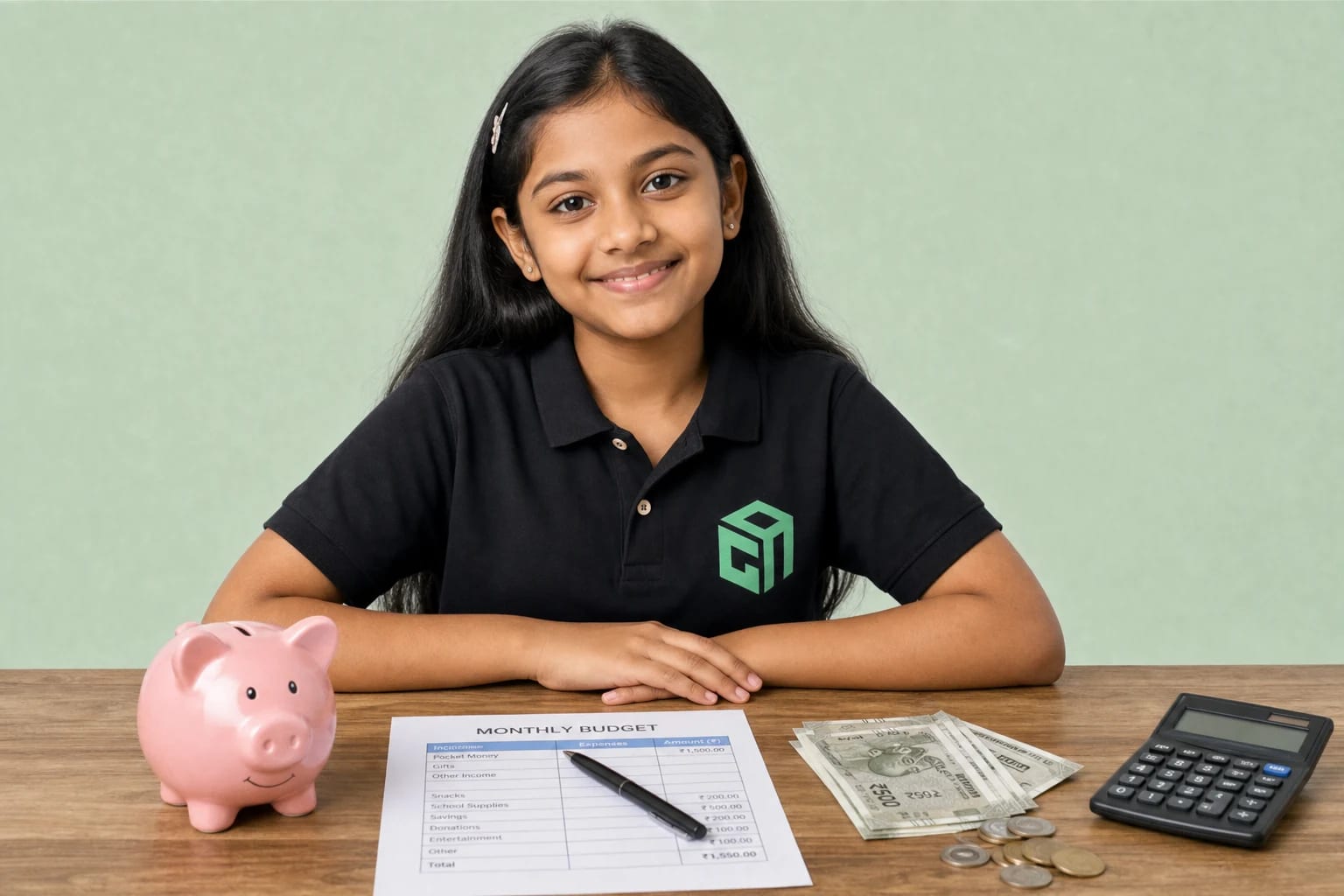
3. A simple budget (₹500 sheet)
A budget is a plan for money you already have. You decide where each rupee goes before you spend it. Practise with pretend money first. There is no one right split. Ask your child why they chose each line.
Example: Aanya gets ₹500 this week (pocket money + a small gift from Dadi). She still wants the science kit, so some money must go in the jar. The rest can go to school things, fun, a gift, and a little surprise money.
| Place | Why | Aanya’s amount | Your child |
|---|---|---|---|
| Savings jar | For the science kit | ₹150 | |
| School or hobby | Notebook and colours | ₹150 | |
| Fun | Snack or a small game | ₹100 | |
| Gifts or sharing | Brother’s birthday card | ₹50 | |
| Surprise | If something breaks or is needed | ₹50 | |
| Total | Must match money in | ₹500 | ₹500 |
| Check | Aanya | Your child |
|---|---|---|
| Money in (income) | ₹500 | |
| All lines added up (expenses + saving) | 150 + 150 + 100 + 50 + 50 = ₹500 | |
| Left (money in − total) | ₹0 — the plan fits |
If Aanya later wants ₹150 for fun, she cannot just add it. She must take ₹50 from another line, or wait. Three words to remember: income (money in), expenses (money out), and left (in minus out).
4. Compare prices before you buy
The lowest price on the shelf is not always the best deal. Look at price, how much you get, quality, and if you will use it.
| Choice | Price | Pages | Cost per page |
|---|---|---|---|
| Notebook A | ₹40 | 100 | ₹0.40 |
| Notebook B | ₹60 | 200 | ₹0.30 |
If both notebooks are fine, B gives more pages for each rupee. Ask your child to pick one and say why. Later they can use the same idea when choosing a coding course: pick what fits the job, not the loudest ad.
5. Income and expenses
Income is money you get. Expenses are money you spend. A weekend bookmark stall makes this clear.
- Sell 10 bookmarks at ₹20 each.
- Total sales: 10 × ₹20 = ₹200.
- Paper and pens: ₹80.
- Money left: ₹200 − ₹80 = ₹120.
Here, ₹120 is profit only if there are no other costs. Sales are not the same as profit. Students learn this in the Entrepreneurship course when they set a price.
6. Profit and loss
Profit is when sales are more than costs. Loss is when costs are more than sales. Easy rule: profit = sales − costs (or loss = costs − sales).
| What happened | Sales | Costs | Result |
|---|---|---|---|
| Cards sell well | ₹450 | ₹300 | Profit ₹150 |
| Cards sell slowly | ₹250 | ₹300 | Loss ₹50 |
Ask what they would change next time: use less paper, make a better card, or pick a price that covers the cost. That is problem-solving, like live coding practice.
7. Cash vs phone payments — stay safe
Cards, UPI, and online checkout still spend real money. A tap is not free. A number on a screen is not unlimited.
- Ask a trusted adult before any online buy.
- Never share passwords, PINs, or OTPs.
- Check the price and how many items before you tap yes.
- Do not click surprise payment links.
- Tell an adult if a message asking for money feels odd.
Practise with pretend checkouts only. Do not use real PINs in a lesson. The Financial Literacy syllabus also covers UPI and scams in live class.
8. Think before you spend
Your child has ₹300. A small toy costs ₹250 today. A bigger item is next month. Ask: Do I need or want this? How much is left after I buy it? Would saving help a bigger goal?
Opportunity cost means: if you pick one thing, you give up another. Kids can still spend on fun. They should just see the trade.
9. Borrowing and interest
Borrowing means using money now and paying it back later. Sometimes you pay extra. That extra is called interest. Class example: borrow ₹100, pay back ₹110 after a month. The extra ₹10 is the cost in this example only.
Real loans can add extra fees. Teach that borrowed money must be paid back. Do not say loans are always good or always bad. The rules matter. Teens who pitch on Demo Day should know that “we will borrow later” is not a plan.
10. Money goals
A goal gives saving a reason. Short goal: a book. Longer goal: a bicycle. Write what they want, the price, money already saved, how much they save each week, and how long it may take. Check together. If the goal changes, write a new plan. That is not failure.
Easy money games at home
These three games need no special kit.
Game 1: Family mini-market
Make a pretend shop with things at home. Put prices on them. Give a set amount of pretend money. The child picks, adds the total, and says what is left. Skills: budget, add, subtract, compare prices, spend with a plan.
Game 2: Mini business
Plan bookmarks, cards, or crafts. Write the cost of materials. Pick a selling price. Guess sales. See profit or loss. If nobody would buy, what would they change? Skills: business, sales, costs, profit, loss. Next step for Class 6–12: the live Entrepreneurship course.
Game 3: Savings challenge
Pick a goal and a weekly chart: money saved, money still needed, possible date. Talk about what helped and what made saving hard. Skills: goals, planning, patience — like tracking the first month of Python projects.
At what age should children learn financial literacy?
| Age | What to try |
|---|---|
| Ages 5–7 | Coins, needs vs wants, a small saving goal |
| Ages 8–10 | A budget, comparing prices, planning a buy |
| Ages 11–13 | Income, expenses, profit and loss, safe phone payments |
| Ages 14–16 | Fuller budgets, interest, borrowing, simple business ideas |
Start with things they already know. Add more when the easy parts feel simple. GeekashramJr’s Financial Literacy course is for Class 3–12, so brothers and sisters can start at different rows in this table.
Practice
Money Skills Quiz for Kids
Ten easy questions for ages 8–14. Print it or do it on the screen. One mark for each right answer.
How can parents help?
You do not need to be a money expert. Talk a little, often. Show how you compare prices, plan a buy, or save for a goal. Skip long lists of bank words.
- Let them make small spending choices that fit their age.
- Ask why, not only what they picked.
- Talk about mistakes without shame.
- Use pretend money and games for the maths.
- Teach safety before any real online buy.
- Link money lessons to maths, coding projects, and entrepreneurship.
Help your child learn money skills
Money skills are more than counting coins. They are choices, plans, costs, and care. Home games build that. A live course adds banks, UPI safety, and a final check, so the skill is practised every week, not once.
Want weekly lessons on budgets, saving, profit and loss, and digital money? See the Financial Literacy course (Class 3–12, live mentors). If your child already has a product idea, add Startup & Entrepreneurship. Book a trial on either page.